How a sleep robot and a patent strategy built a company that changes lives
In 2016, a group of Dutch robotics students set out to solve a deeply personal problem: insomnia. Julian Jagtenberg's mother had been battling sleeplessness for years, her anxiety preventing her from finding peace at night. Julian, along with classmates at Delft University of Technology, decided to do something about it.
Their early experiments combined technology with tenderness: sensors, pumps, and algorithms paired with softness, warmth, and human intuition. What began as a student project quickly attracted international media attention, and before long, insomniacs from around the world were emailing the team on their university accounts, begging to try the device.
That was the moment Somnox was born.
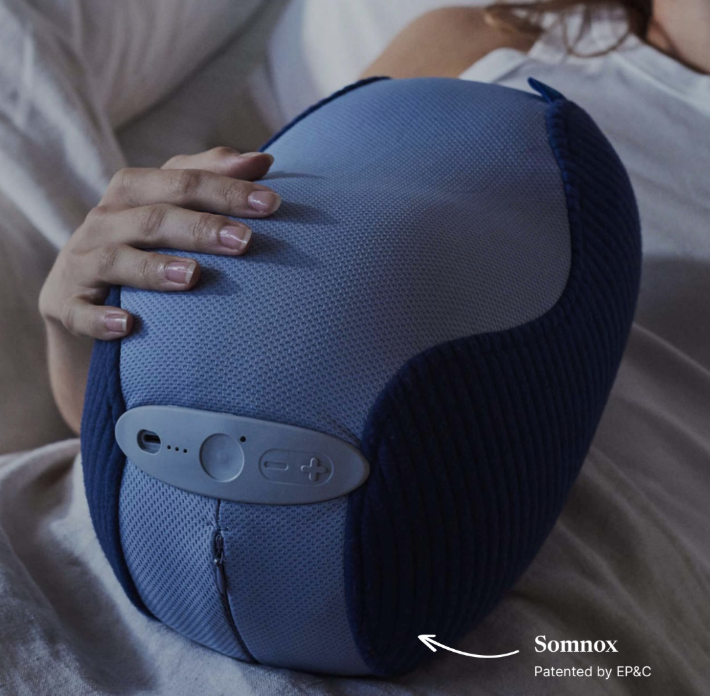
Today, Somnox is a profitable company based in Rotterdam with one mission: to help 100 million people sleep better by 2030. At its heart is the Somnox 2, a soft, sensor-packed “breathing companion” designed to calm the body through synchronised breathing and gentle, comforting presence. But the journey to get here was anything but restful.

Inventing a new category
Somnox didn’t just create a new product; it pioneered a new category. Their sleep companion isn’t quite a medical device, nor is it a simple consumer gadget. It’s not a pillow, not a plush toy, and not a speaker - though it shares elements of all three. This ambiguity has made marketing complex and consumer adoption unpredictable.
As Julian puts it, “There was no playbook. No product to benchmark against. We had to educate the market from day one.”
This challenge was compounded by the scepticism of sleep-deprived consumers who had already tried everything: expensive therapies, herbal teas, white noise machines. Somnox needed more than a great product. It needed trust.
Why patents mattered from the start
From the very first prototype, Somnox prioritised intellectual property. “We knew that if we wanted to attract investors and scale manufacturing, we had to secure what made our technology unique,” Julian says.
That’s where EP&C came in. Working closely with Somnox’s engineers, the firm helped identify and protect the essential elements of the product: the silent air pump, the breathing algorithm, the smart sensor array, and the design features that made the device feel human rather than mechanical.
EP&C’s support wasn’t limited to patent filings. They monitored global competitors, flagged potentially infringing developments (including one by Philips), and advised on how to adjust protection as the product evolved.
.png?width=870&height=573&name=Somnox%20header%20(1).png)
Failing, listening, evolving
The first version of Somnox was large and industrial. Customers found it heavy and cumbersome. But rather than doubling down, the team listened. They made it smaller, softer, more intuitive. They added Bluetooth streaming, a snore sensor, and a memory-foam core. Every detail - from the washable fabric covers to the layout of nighttime controls - was redesigned with the user in mind.
Their most surprising discovery? Customers responded emotionally to the device when it had a friendly form, even giving it names and treating it like a companion. “We resisted that for years,” Julian says. “We thought it would make the brand look childish. But it turned out to be the key to emotional connection.”
Somnox leaned into this insight, eventually adding a bear-like design and branding future models for different audiences, including children and elderly people with dementia.
From hardware to habit
One of Somnox’s greatest challenges has been changing user behaviour. Holding a breathing device in bed is not a typical way to sleep. Building a nightly routine around it requires more than good design - it takes coaching.
That’s why the Somnox app has become just as central as the hardware. It includes guided meditations, cognitive behavioural therapy exercises, and personalised insights. Over-the-air updates continuously improve the device’s algorithm, based on anonymised sleep data from thousands of users.
With over 35,000 devices used nightly, Somnox has access to a growing dataset of real-world sleep behaviour - something no traditional consumer product can match.
From survival to profitability
Like many hardware startups, Somnox teetered on the edge of failure more than once. International expansion proved costly. Economic downturns and energy crises affected consumer confidence. At times, the team days away from making good on the payroll.
But in 2024, Somnox became profitable. That moment marked more than a financial milestone; it was emotional validation for a team that had risked everything.
Julian reflects, “The only reason we kept going was because of the stories. Customers telling us the product changed their lives. That they finally slept through the night. That they no longer felt alone.”
What comes next
The next chapter is already in motion. Somnox is preparing new products aimed at broadening the market.
“We’re not solving the root causes of anxiety or grief or trauma,” he says. “But we are helping people cope. Helping them feel calm, comforted, less alone. That’s something worth building a company around.”
Once again, EP&C is involved from the earliest design sketches, ensuring the next round of innovations is properly protected.