Investor René Reijtenbagh on the role of intellectual property in startups.
For startups, investors are often indispensable when it comes to further developing an innovation and bringing it to market. Investors, in turn, want to be confident that they are putting their money into ventures with a strong potential for return. “An IP strategy is crucial because it is the ultimate proof that your technology is unique and that it belongs to your company,” says investor and CEO of Business Angels Connect, René Reijtenbagh.
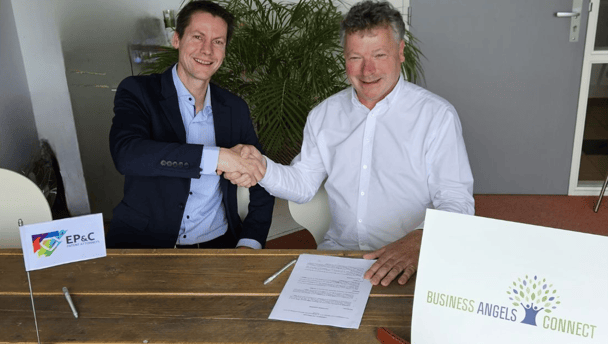
Mark Jolink (EP&C) en René Reijtenbagh (Business Angels Connect).
What investors look for
René founded Business Angels Connect (BAC) in 2017 to support innovative startups and scale-ups in green chemistry, circularity, health, life sciences, and agrifood. BAC helps entrepreneurs prepare for collaboration with investors and connects them with private investors. Through his work at BAC, René sees firsthand how important a well-thought-out IP strategy is in attracting investment.
According to René, investors focus on three key aspects. “First, they want to know whether ownership of the intellectual property is unquestionably in the hands of the company. Second, they look at the patent claims. A thorough technical due diligence process is essential here. How promising is the innovation, and what risks are involved? The third question is whether the innovation is commercially viable. Something may be unique and legally protected, but it also needs to have real market potential.”
The chicken-and-egg problem: Investor first or patent application first?
René’s position is clear: a patent or patent application is essential for attracting investors. Yet many startups face a classic chicken-and-egg dilemma. You need investors to finance a patent application, but investors often want to see a patent application before committing.
René advises entrepreneurs to invest in the process themselves, but to start small. “An initial patent assessment typically costs between €3,000 and €5,000. That is usually manageable, and if not, there are often vouchers or innovation grants available. These can help fund a novelty search, allowing you to demonstrate to investors whether your innovation has potential and is patentable. After that, you still have a year before you need to file the patent application.”
Investors as owners of intellectual property
A novelty search report provides valuable insight into the potential of an innovation. Armed with such a report, entrepreneurs are in a stronger position when approaching investors, who may then be willing to finance the next stages of the patent process.
René has personal experience with this as an investor. “I once invested in the continuation of a patent application. The patent was subsequently filed worldwide. Through that investment, I became a partial owner of the technology and the associated patent claims. For investors, ownership of intellectual property can be highly attractive. However, entrepreneurs need to be willing to invest in the first steps toward obtaining patent protection.”
Intellectual property is becoming even more important
With nearly thirty years of experience connecting entrepreneurs and investors, René has seen the role of intellectual property evolve over time.
“It has always been important and, in my view, it has always been one of the first things investors look at,” he says. “What has changed is that investors now have access to a much larger pool of high-quality opportunities. As a result, patents have become an even more important criterion during the initial selection process.”
He also sees the rise of AI affecting the innovation landscape. “AI is accelerating development cycles. As a result, I see patent applications being filed earlier and more quickly than before.”
Investors look at the complete picture
René emphasizes that having a patent is not the sole deciding factor for investors. A company may have outstanding technology, significant market potential, and strong patent protection, but the relationship between entrepreneur and investor also matters.
“If personalities clash, an investment is unlikely to succeed,” René explains. “Investors look at the complete picture: what assets does the company have, is the technology unique and protected, but also, can we work together?”
Practical advice for startups
René’s advice for startups is straightforward: do not view a patent application as a cost, but as an investment in your negotiating position.
“If an investor is presented with a clear IP strategy and understands the reasoning behind the decisions that have been made, it creates confidence. It shows that the entrepreneur understands what investors are looking for. That is something worth investing in. Trying to save money here can be costly in the long run. If your intellectual property is not properly protected, investors are less likely to trust the opportunity, and your company runs the risk of someone else capitalizing on your innovation.”
The collaboration between Business Angels Connect and EP&C
Business Angels Connect and EP&C work together to help startups and investors prepare for the protection of innovations.
René explains: “When we see that a company’s IP strategy or patent approach requires attention, we introduce them to EP&C. The first step is accessible and non-committal, but it already provides valuable insight into the potential of their technology before they start discussions with investors.”