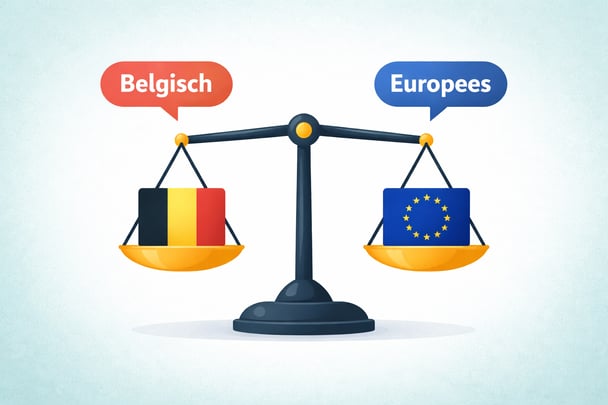
When you want to apply for a patent, you are immediately faced with a choice: where will you do it? Do you start with a Belgian patent application, or do you go straight for a European patent application? Both procedures have their own advantages and disadvantages. In this blog, I explain the key differences and where they are similar.
1. Examination
The biggest difference is the examination. Belgium uses a registration system. This means you will always obtain a patent in Belgium, because there is no substantive examination. You do receive a high-quality novelty report with a written opinion prepared by the European Patent Office (EPO). The Belgian application is assessed against patentability requirements, including novelty and inventive step. This assessment is only an opinion and does not affect the decision to grant a patent. Even with a negative novelty report, you will still obtain a patent in Belgium.
For a European patent application, a substantive examination is carried out by an EPO examiner. If you receive a novelty report with a negative opinion, you as the applicant must enter into discussion with the examiner to defend or amend the application in order to obtain a granted patent.
2. Processing time
The difference in examination also leads to a difference in processing time. In Belgium, you typically obtain a patent about 18 months after filing. It is also possible to accelerate the grant in Belgium, provided you explicitly request this and all formal requirements are correctly fulfilled. In Europe, it takes on average three to five years to obtain a European patent.
3. Territorial scope
A Belgian patent provides protection only in Belgium. With a European patent, you have two options after grant. You can choose to validate the patent in the countries that are part of the European Patent Convention. This means validating the patent separately in each country. The second option is a unitary patent, which provides immediate protection in all 18 countries currently participating in this system. It is also possible to combine both options, for example by choosing a unitary patent and additionally validating the patent separately in the United Kingdom.
4. Costs
Filing costs and associated fees for a Belgian application are significantly lower than for a European application. Official fees for a Belgian application are around €350, while the mandatory official fees for a European application are often around €4,000 to €4,500. This difference is further increased because the European grant procedure includes substantive examination by the EPO.
In addition to filing costs, there are annual maintenance fees. In Belgium, these are relatively low. For a European patent, depending on the number of countries where validation is requested, these costs can be considerably higher. In return, a European patent offers broader territorial protection in participating countries.
5. Language requirements
For a European patent application, you can choose between English, French, or German. In Belgium, the situation is more complex. Individuals can choose between Dutch, French, and German. Legal entities are tied to the location of their registered office. The language you must use depends on where your headquarters is located.
A key advantage of a Belgian patent
At this point, a European patent might seem more attractive. Still, there are strong advantages to starting with a Belgian patent application. One of them is that after about eight months, you receive a high-quality novelty report from the EPO, assessing both novelty and inventive step. This gives a clear indication of your chances of success if you decide to pursue a European follow-up application. It is a valuable first step that helps you shape your strategy without incurring high costs.
Start with a Belgian patent
Most of my clients start with a Belgian application. That is often our advice as well. If you already know you want to continue with applications in other countries, the location of your first filing matters less. What matters most is the filing date. That date is crucial, because anyone who comes up with your idea after that moment is too late. After one year, you can decide to expand, for example to Europe or internationally.
In summary, the advantages of starting in Belgium:
• Lower filing costs.
• A relatively fast grant, usually after 18 months.
• A high-quality novelty report from the EPO.
• Time to further develop your innovation and explore the market.
Only in Belgium
Starting in Belgium does not mean it ends there. In most cases, it is just the beginning. In very specific situations, companies choose to remain with a Belgian patent only. For example, for tax benefits. A patent can also be useful for marketing purposes, as it allows you to communicate that your product is patented.
Need advice on your patent strategy?
The choice between a Belgian and a European patent depends on your specific situation and strategy. Do you want to know which approach works best for your innovation? Feel free to get in touch. I would be happy to advise you.