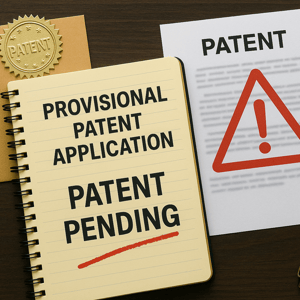
You’ve developed a promising innovation and want to make sure it’s properly protected. A quick Google search may lead you to the term “provisional patent application.” It can look like an attractive option: no complex patent filing, low cost, and the right to use the phrase patent pending. But in reality, a provisional patent application comes with more pitfalls than advantages. In this blog, we explain what it is — and which alternatives offer stronger protection.
What is a provisional patent application?
A provisional patent application is a preliminary filing that is only available in the United States. For roughly $70 to $350, you can secure a priority date, establishing that you were the first to come up with the idea. It also requires relatively little effort, as it does not need to meet the formal requirements of a full patent application. In fact, you can even submit a working document to the United States Patent and Trademark Office.
Once filed, you have twelve months to submit a full patent application that does meet all formal requirements. On the surface, it seems like an easy, inexpensive way to secure a priority date and claim patent pending.
The hidden pitfalls
Attractive as it may seem, there are some significant risks. The biggest one is that Europe applies much stricter rules for amending patent applications than the US. Imagine you file a provisional application with only a high-level description, which is allowed. Later, you want to file a European patent based on that provisional.
In that case, you are only allowed to use the literal content of the original provisional. If that text does not contain proper claims or enough technical detail, you cannot add them later for Europe. This means you may end up with an application that does not meet European formal requirements and cannot lead to protection there.
Cheap can become costly
Submitting a provisional patent application yourself with a credit card may seem like an inexpensive shortcut. But filing it starts an entire timeline. Follow-up deadlines are fixed and cannot be repaired once missed. Losing track of them can result in a failed protection strategy, especially if the invention has already been made public.
The risk of disclosure
If you publicly disclose your invention after filing the provisional, but fail to convert it into a full application within twelve months, you may permanently lose the possibility of obtaining a patent on anything you disclosed.
Better alternatives for Dutch businesses
Fortunately, there are more suitable options for entrepreneurs in the Netherlands.
Dutch patent application
You can file a regular Dutch patent application that meets the necessary formal requirements. If you file it without paying the fees for filing and the novelty search, you still obtain a twelve-month priority period, but with a stronger basis for later European or international expansion. If you do pay the official fees, you’ll receive a Dutch registration patent after 18 months.
i-Depot
An i-Depot allows you to record that you owned a particular idea or design at a specific point in time, for a small fee. It timestamps your documents without starting a patent procedure. While it does not grant patent rights, it can be useful as supporting evidence in negotiations or disputes. Always use an i-Depot in consultation with a patent attorney to ensure you record the right information and avoid risks.
Choose the option that fits your situation
For US-based companies, a provisional patent application can be a useful tool. For Dutch companies, we generally do not recommend it. It offers limited value and often causes more harm than good.
Do you want to protect your invention as a Dutch entrepreneur? Start by seeking advice from a Dutch patent attorney. They can help you identify the options that truly align with your goals and ambitions.
Would you like tailored advice on the best route for your innovation? Feel free to contact us.
.png?width=1070&height=410&name=EP%26C_CTA_de%20meerwaarde_1070x410px%20(1).png)