Greenhouse growers face an uncomfortable paradox. They can produce high-quality food at scale, but the work still depends on people willing to cut leaves, monitor plants and harvest fruit in hot, repetitive conditions.
Ruud Barth, CEO and Founder of SAIA, decided the answer was not a better robot in the same old greenhouse. It was a different greenhouse.
This is a story about plants, patents and a startup learning how to protect a category before that category fully exists.
Start with the plant, not the machine
Most automation stories begin with a machine. SAIA’s begins with a tomato plant.
For Ruud Barth, the central problem in greenhouse automation was not that robots lacked intelligence. It was that the greenhouse had been designed around human bodies. People can bend, reach, step around vines and make sense of a living system that grows in unpredictable ways. Robots find that much harder.
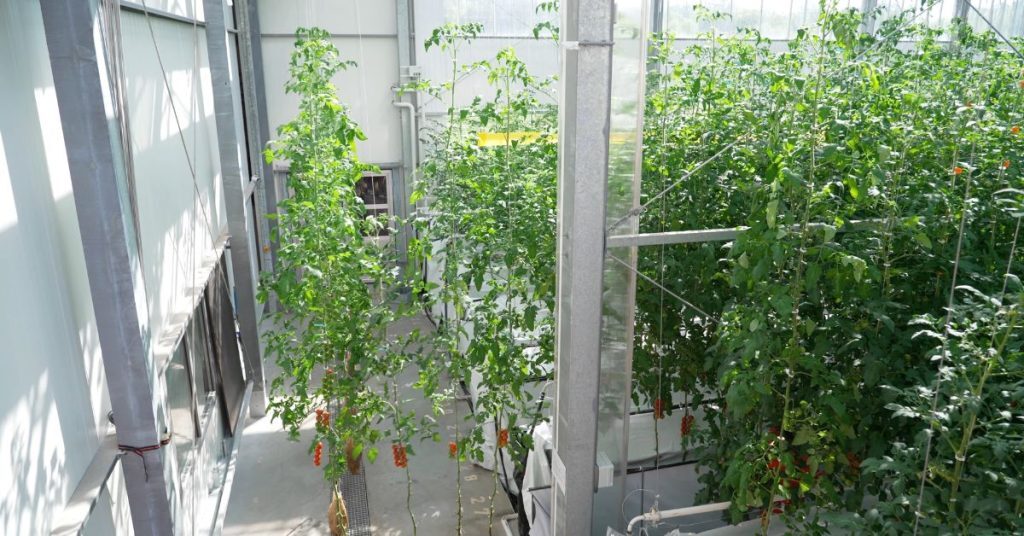
Traditional tomato plants can grow to extraordinary lengths. They twist, tangle and stretch through the greenhouse. Ruud describes the result as something close to spaghetti. That world suits an experienced grower, but it creates a hostile environment for automation.
SAIA asked a different question. Instead of forcing robots into the “jungle” of the greenhouse, the company asked whether the plant itself could change.
That decision shaped the company’s first two years. Ruud says SAIA effectively became a plant company before it became a robotics company. The team studied how tomato plants behaved, what they tolerated, what stressed them and how they responded when their growing conditions changed. The work meant rethinking roots, water, nutrients, plant balance and movement.
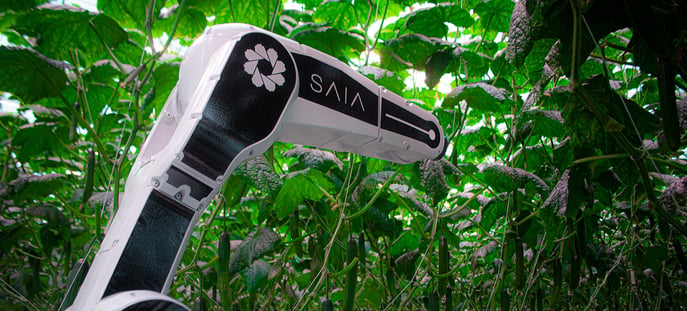
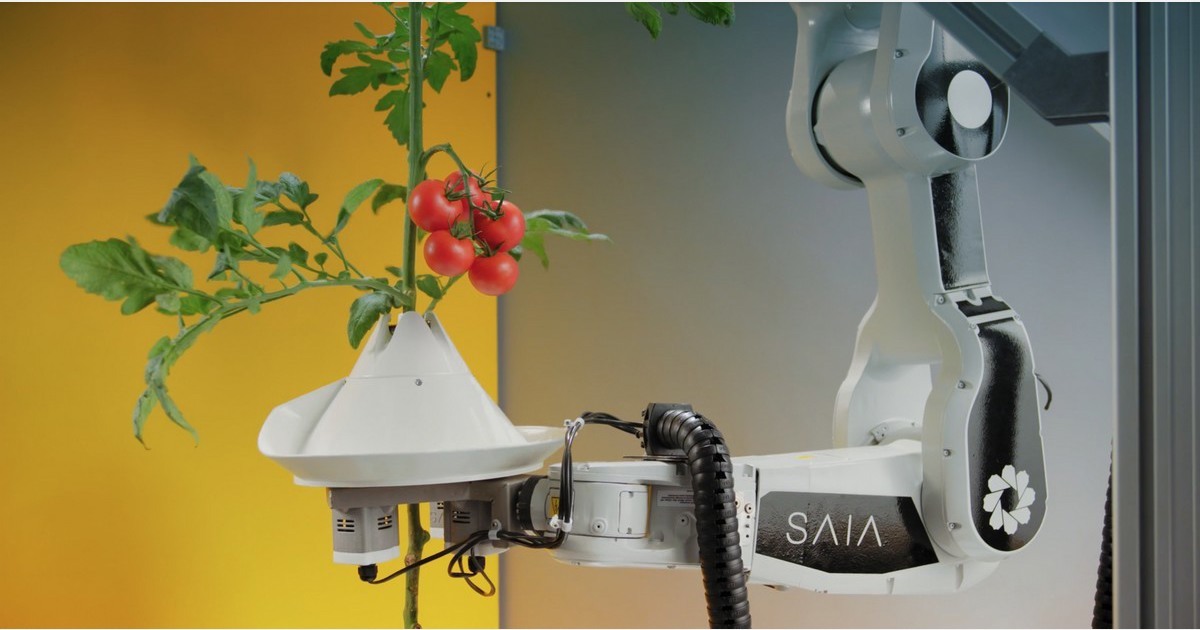
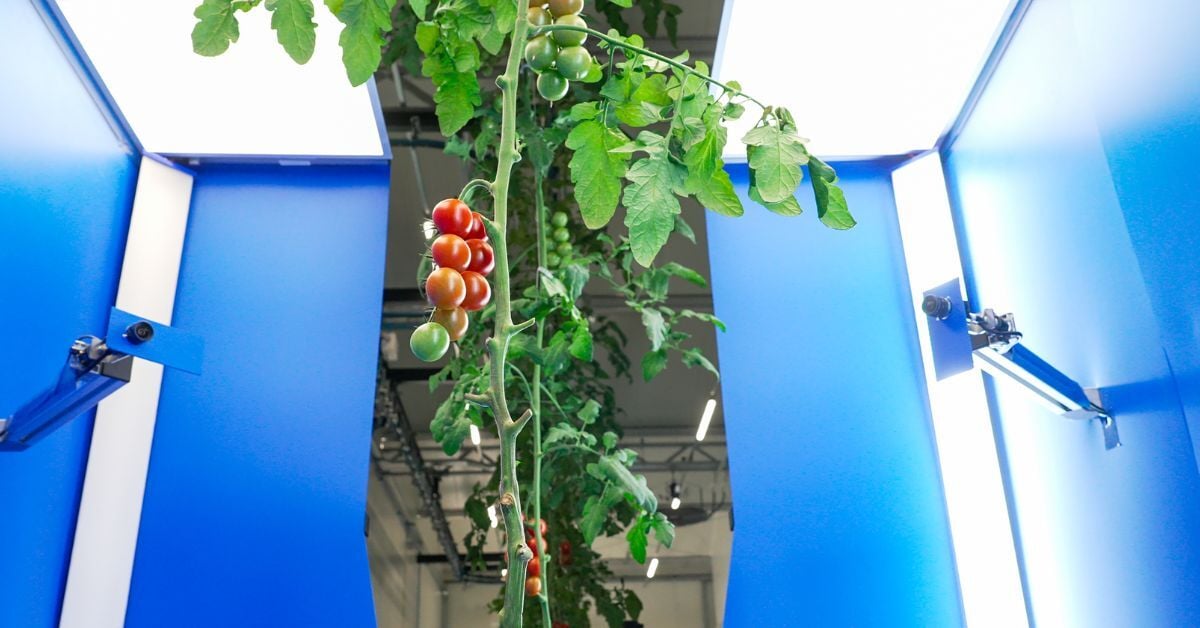
The insight was deceptively simple: make the plant vertical, movable and accessible. If the plant could come to the robot, the robot no longer needed to navigate the plant.
SAIA now describes its system as a patented automation solution combining a mobile plant system, AI and robotic harvesting. Its greenhouse model reverses the usual logic: plants move, AI monitors the crop and robots perform the work.
The side quest that became the main quest
SAIA did not invent every biological principle behind its system. Ruud openly acknowledges that researchers had explored aspects of lowering and re-rooting plants decades earlier. The breakthrough came from seeing old knowledge through a new strategic lens.
The original aim was automation. The team wanted a plant architecture that made robotics easier. But the plant system became more than a support mechanism. It became the foundation of the business.
Ruud talks about tomato plants that can keep producing for years. He calls the idea a “perpetual tomato machine”. The phrase sounds playful, but the management lesson is serious. Sometimes the enabling technology becomes the core technology. Sometimes the detour becomes the market.
This matters because greenhouse horticulture has reached a point where incremental improvement no longer feels enough. Ruud describes the sector as sitting near the top of an S-curve. Dutch growers have spent decades improving yields, refining climate control and building one of the world’s most advanced greenhouse ecosystems. Yet labour shortages, rising expectations and the need for more data-driven growing have exposed the limits of the existing model.
Growers do not lack operational skill. They lack room to move.
SAIA offers a new operating model. It does not promise to remove people from food production altogether. Ruud frames the goal more carefully: remove the repetitive, physical and hard-to-manage labour that makes greenhouse operations difficult to scale.
That distinction matters. Automation works best when it helps people manage complexity, rather than pretending complexity no longer exists.
From machinery to technology
SAIA sits at the edge of a broader shift. Many companies begin by making equipment. Fewer make the transition into technology companies.
The difference lies in what they protect, sell and learn from.
A manufacturing company sells a product. A technology company builds a system that can improve, compound and create strategic options over time. For SAIA, the robot is only one part of that system. The wider proposition includes plant movement, crop data, AI monitoring, harvesting, pruning, plant selection and the possibility of licensing parts of the surrounding ecosystem.
Ruud is clear about the commercial logic. SAIA wants to build the core robots itself. Around that core, some patents may support licensing. That creates a business model with more flexibility than hardware sales alone.
The move from machinery to technology also changes how a company thinks about intellectual property. Patents stop being paperwork at the end of an invention process. They become part of the architecture of the company.
Ruud puts this bluntly. For SAIA, patents are fundamental to keeping innovation alive. Without them, a startup can spend years opening a new category, only to see larger or faster competitors run ahead with the insight.
That fear is not theoretical. SAIA operates in a field that attracts interest from robotics, automotive, heavy industry, medical technology and software. Many entrants see agriculture as a promising market for existing automation skills. Ruud’s view is that many fail because they start with the robot, rather than the plant.
SAIA’s patent strategy protects that inversion.
Claiming the domain
Ruud describes patents as a way to “claim your domain”. That phrase captures more than legal defence. It captures territory, timing and confidence.
A young technology company needs time to develop. SAIA has spent years building its system and still sees further work ahead before broad market adoption. In an innovative sector like horticulture, which is often rooted in family-owned businesses focused on long-term stability, growers need proof across seasons, conditions and production cycles. They need to see that the plant performs, not once, but repeatedly.
Patents help create that runway. They also help the company communicate seriousness to investors and partners.
EP&C’s own SAIA case study notes that SAIA has filed patent applications across several areas, including robot tools, the cultivation system and the process of selecting and moving groups of plants in the greenhouse. The same case study explains that patents help protect against copying, attract investors and show partners that the company has technology worth building around.
That is the heart of strategic IP. It does not protect an isolated idea. It protects the company’s ability to keep learning.
Ruud’s language is revealing. He talks about patents enabling innovation to “compound”. In other words, each protected step creates room for the next one. A company can invest, test, improve and disclose enough to build credibility without surrendering its future.
The role of Thomas Remmerswaal
In this story, Thomas Remmerswaal is not a distant legal adviser who appears when forms need filing. He plays a more strategic role.
Ruud says EP&C has been with SAIA from the beginning. The relationship endured because Thomas quickly understood the technology. In meetings with Ruud and co-founder Bart van Tuijl, a few sketches could be enough. Ruud recalls that they often needed no more than 15 minutes to discuss a new patent direction before Thomas could begin shaping the claims.
That speed matters in a startup. Founders cannot pause invention for long legal translations. They need an adviser who can move between engineering, biology, robotics and commercial strategy without losing the thread.
Thomas brings that technical fluency. EP&C describes him as a patent attorney with a background in mechanical engineering and materials science from Delft University, and his listed specialist industries include horticulture, packaging, offshore, infrastructure, metallurgy, consumer products and designs.
The most telling moment came when SAIA’s cultivation system looked difficult to protect. EP&C’s case study explains that Thomas helped with patent database research and found older patents that seemed to describe parts of the idea. Rather than treating that as the end, he helped SAIA describe the innovation from new angles so it could still be patented.
That is where a modern patent attorney creates business value. The work is not only about knowing the law. It is about seeing what is technically new, what is commercially important and what language gives an invention room to grow.
Strategy before scale
SAIA’s market also demands patience. Ruud describes growers as careful, busy and understandably risk-aware. Their plants are sacred to their operations. A new system cannot arrive as a theatrical disruption and expect instant trust.
Instead, SAIA has to earn confidence in stages. First, the plants must prove themselves. Then the automation can follow. Growers need several seasons of evidence before they commit at scale.
That creates a management challenge familiar to many deep-tech companies. The technology may be radical, but adoption must feel manageable. SAIA has to be visionary in its architecture and pragmatic in its rollout.
Recent market signals suggest the company has moved beyond concept. In November 2025, StartLife reported that SAIA Agrobotics, a Wageningen University & Research spin-off and StartLife alumnus, raised €10 million in Series A funding to scale its robotics platform for high-tech greenhouses, bringing total funding to more than €20 million. The same report stated that SAIA aims to increase yields by 20% and reduce total greenhouse labour by 50%.
Those numbers are ambitious. Yet the underlying idea remains rooted in Ruud’s first principle: make the biological system easier to automate before making the robot more complex.
Data, taste and the limits of algorithms
The future SAIA imagines is not only mechanical. Once plants move through a controlled process, each plant can become a source of data. Cameras can scan fruit, systems can monitor performance and growers can build a more precise picture of production.
That shifts greenhouse management from manual observation towards operational intelligence. The grower becomes less like a supervisor of endless physical tasks and more like the strategist of a living production system.
Ruud sees this future clearly. Climate strategies, growing strategies and production strategies could become more automated over time. Yet he resists a simplistic view of farming as software. Nature, as he puts it, always has “a quirky way of dealing with stuff”.
That humility gives the story its tension. SAIA wants to industrialise parts of greenhouse horticulture, but it cannot flatten biology into a spreadsheet. Taste still matters. Plant health still matters. The grower’s expertise still matters.
This is where SAIA’s plant-first approach feels hopeful. The company did not begin by asking how to maximise mechanical efficiency at any cost. It began by asking what the plant needed in order to make automation possible.
That sequence gives the technology a different character.
The Dutch advantage
SAIA also draws on a deeper Dutch tradition. The Netherlands has spent generations improving controlled growing environments, from early glasshouses to today’s high-tech horticulture sector. Ruud sees SAIA as part of that lineage: another step in the Dutch habit of making food production more efficient, more scalable and more inventive.
The ambition extends beyond the Netherlands. SAIA’s own vision states that every community should have access to local, high-quality fresh food, and that autonomous indoor farming can help controlled environment agriculture become more accessible and affordable.
That vision carries weight because food production faces pressure from multiple sides: labour scarcity, climate stress, water constraints and rising expectations for fresh produce. SAIA does not solve all of that alone. No single company does. But it offers a striking example of how a better question can create a new path.
Do not send the robot into the jungle. Bring the plant into a system designed for precision.
The patent lesson for innovators
For EP&C, the SAIA story shows why patent strategy belongs close to business strategy.
A company that waits too long to protect its inventions may lose the ability to shape its own market. A company that protects too narrowly may hold patents that fail to support its future model. A company that treats patents as isolated legal assets may miss their deeper value: they help define what the company is becoming.
SAIA is not protecting a single machine. It is protecting a way of growing, moving, reading and working with plants. That gives the company options as it scales: manufacturing, licensing, partnerships, data-led services and continued product development.
Thomas Remmerswaal’s role sits at that intersection. He helps translate invention into defensible territory. He helps founders move quickly without losing strategic depth. He helps turn sketches into claims that can support a company’s next phase.
For Ruud, that relationship has become part of the rhythm of innovation. Sometimes SAIA speaks with EP&C weekly. Sometimes months pass quietly. The continuity matters because Thomas already understands the context when the next invention emerges.
A different kind of greenhouse
The most surprising part of SAIA’s story is not the robot. It is the patience.
The company spent years studying plants before asking machines to act. It accepted that growers need proof before change. It treated patents not as a defensive afterthought, but as a way to protect the time and space required for a new category to mature.
That is how manufacturing businesses become technology businesses. They stop seeing innovation as the next product and start seeing it as a system of knowledge, protection and strategic choice.
SAIA’s future is still unfolding. The promise is tangible: fewer repetitive tasks, better visibility, stronger yields and a greenhouse model that may make fresh food easier to produce closer to where people live.
The lesson for other innovators is clear. Protect the idea early, shape the strategy around it and work with advisers who understand both the invention and the business it could become. For companies building the next generation of food technology, that may be the difference between having a clever machine and owning the future it makes possible.