Soltech is reimagining the building envelope as a source of energy, identity and intelligence. For CEO Bas van de Kreeke, that means turning a specialist manufacturer into a technology company. For Jeroen at EP&C, it means building a patent strategy that protects more than products. It protects the system behind them.
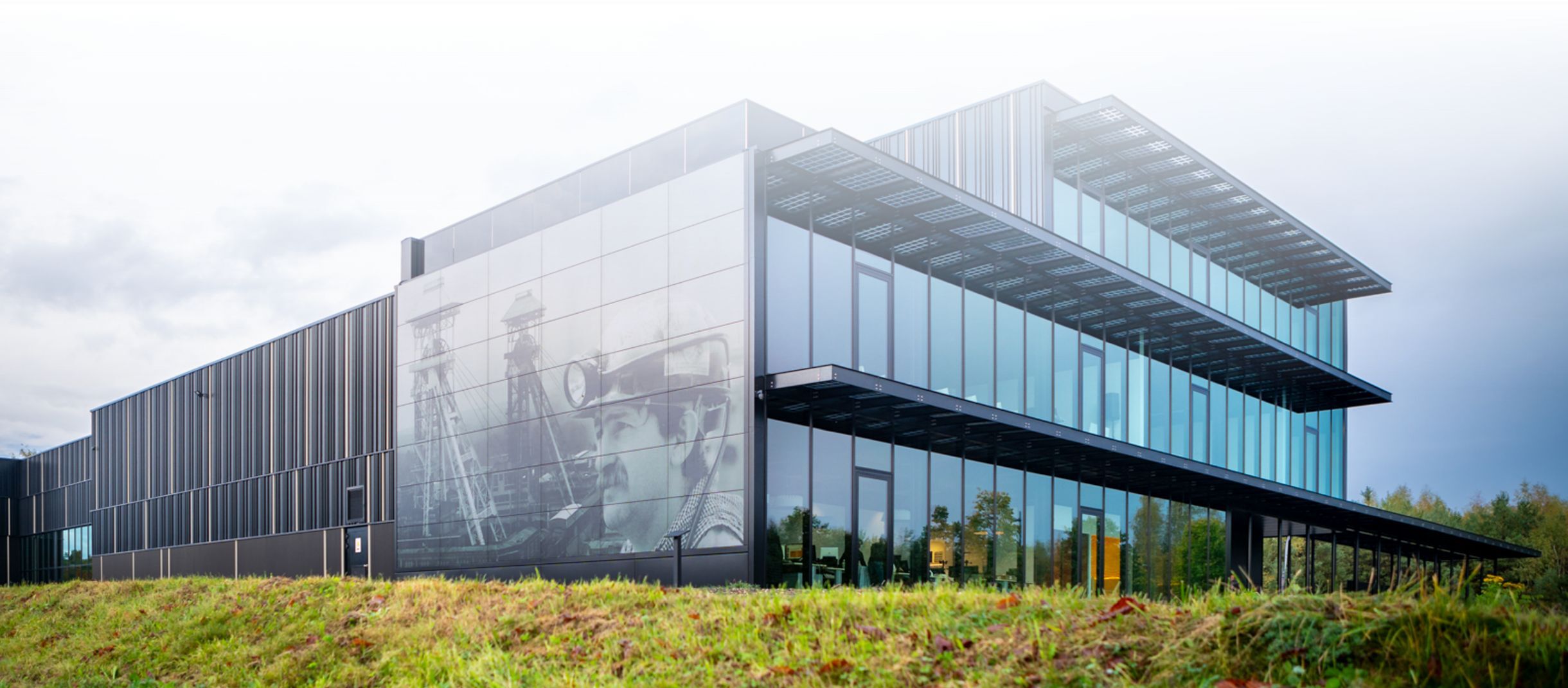
At Thor Park in Genk, on ground once defined by extraction, Bas van de Kreeke is working on a different idea of production. He leads Soltech, teaches as a guest professor at UHasselt, and brings the instincts of a lifelong construction man into a company that began as an imec spin-off in photovoltaics. The setting could hardly fit better. Thor Park was designed as a place where science, business, education and technology meet, with a strong focus on energy transition, smart manufacturing and smart city applications. Soltech’s current chapter now sits at the centre of that ecosystem. (UHasselt)
What Van de Kreeke sees in a building is not cladding, glazing or dead surface. He sees latent capacity. A wall can generate power. A pane of glass can carry light. A façade can disappear into the skyline by day and speak to the city by night. To him, the surprise is no longer that technology can do these things. The surprise is that the market has only recently started to imagine them properly.
That shift in imagination may be the real story of Soltech.
Because Soltech is no longer only the company that manufactures beautiful solar elements. It is becoming something more ambitious and, in many ways, more defensible: a technology company that uses materials, software, data, automation and patent strategy to change what a building can be.
The second life of a Belgian pioneer
Soltech’s roots go back to 1989, when it was founded as a spin-off from Imec and emerged early as a pioneer in photovoltaics. Over time, it built deep know-how in integrated solar applications and custom modules for architecture. But being early is not the same as being scalable. In 2021, after struggling to make the jump from R&D to competitive production, the company relaunched with Van de Kreeke and a group of industrial and financial partners behind it. In Genk, it has since built a highly automated, energy-neutral factory and a new operating model that is far more industrial than its first life ever was.
That rebirth matters because Soltech did not win by abandoning its complexity. It won by learning how to organise it.
Van de Kreeke understood that from the start. He did not arrive as a solar purist. He arrived as someone who knows what it means to make products work in the unforgiving reality of construction, where delivery dates matter, tolerances matter, certifications matter and nobody buys a façade because the engineering sounds elegant.
That background changed the language inside the company.
One of the most revealing things he says is also the simplest: “We don’t make solar panels. We are a building materials company.”
That sentence is not branding. It is strategy.
For years, many conversations in integrated photovoltaics began in the wrong place, with euro cents per watt peak, cell efficiency and technical abstraction. That works if you are selling into the traditional solar market. It does not work if you are speaking to an architect, façade engineer or developer staring at an elevation drawing and thinking about wind load, fire resistance, structural performance, delivery sequence, finish and visual coherence.
So Soltech changed the grammar of the conversation.
Instead of asking customers to think like solar buyers, it learned to speak like a construction and design partner. It talks about façades that can survive on the 25th floor. It talks about glass thickness, mechanical performance and certified building elements. It talks about colour, texture and freedom. It talks about energy too, but only once the design conversation makes sense.
That is how categories move. They do not move when technology gets louder. They move when technology becomes legible to the market.
From custom manufacturer to technology platform
At first, Soltech behaved like many inventive firms do when they discover the sheer elasticity of their own capabilities. It tried to be infinitely custom. Tell us what you want, the company seemed to say, and we will make it.
Van de Kreeke learned quickly that absolute freedom can overwhelm customers. Architects need possibility, but they also need handles. So Soltech started to package its offering into named product families, from refined dark glass finishes to semi-transparent or image-bearing surfaces. That move looked commercial on the surface, but it was operationally important too. It turned craftsmanship into a platform language. It made innovation easier to specify, easier to discuss and easier to sell.
This is where the story starts to feel less like advanced manufacturing and more like software thinking.
A manufacturer makes units. A technology company creates repeatable systems that can still flex at the edges. Soltech is now much closer to the second model.
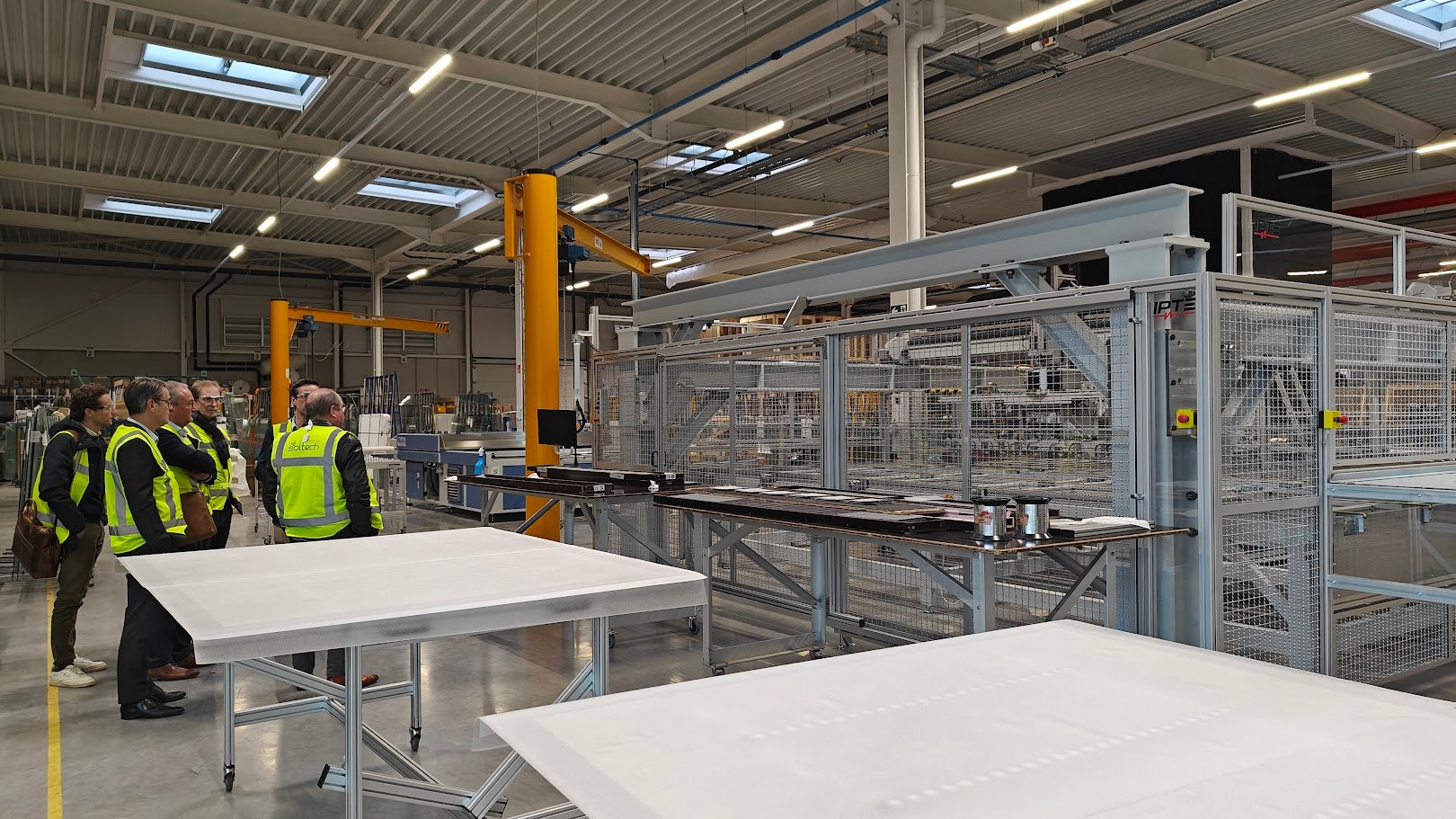
Its factory in Genk was built for that logic. The production process is digitised from end to end, using customised machines and a set-up designed to handle flexible, high-variation work rather than only long uniform runs. Soltech describes the line as a mix of local production and R&D, capable of moving between prototyping, early-stage development and serial production. On its own site, the company says innovation is not a separate department but the engine behind everything it does.
That matters because Soltech does not want to win the commodity race. It cannot, and it should not try.
The company is not chasing the logic of standard solar panels. It is chasing something harder and potentially more valuable: the ability to deliver a different colour, finish, transparency level and performance profile without breaking the economics of manufacturing.
In Van de Kreeke’s telling, that is where the business becomes genuinely interesting. Every architect wants a slightly different answer. Blue is never only blue. It is dark blue, pale blue, less reflective blue, a blue that recedes into the sky, a blue that behaves differently in winter light. Every one of those aesthetic decisions has an electrical consequence. Every one of them can affect output, durability, integration method and expected payback.
So the real challenge is not only to manufacture the panel. It is to predict it.
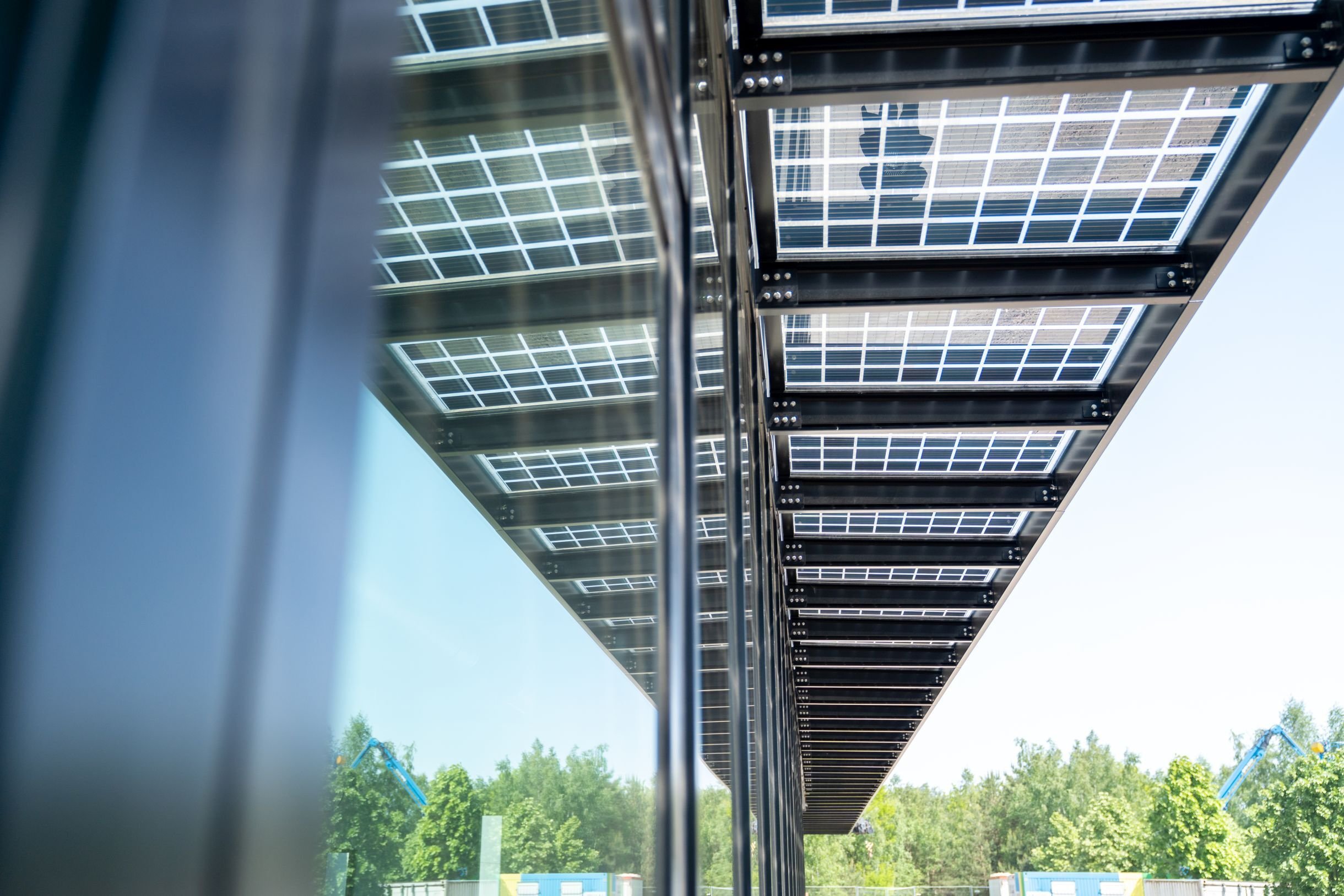
That is the second, deeper surprise in the Soltech story. The company’s advantage does not sit only in the visible product. It sits in the invisible system around the product: the design tools, the production intelligence, the flashing and testing, the quality control and the feedback loop that sends what the factory learns back into the next design decision.
At one point in the interview, Van de Kreeke describes how Soltech has built up a large historical database of measurements and is now using that knowledge to predict the likely performance of future panels with much greater accuracy. That is not the language of a traditional manufacturer. That is the language of a company moving towards a proprietary technology stack.
The building material is still glass. The differentiator is increasingly information.
The role architects have been waiting for
This is also why Soltech feels so important to architects.
For decades, sustainable technology often arrived as compromise. You could have the clean energy, but not the clean façade. You could have performance, but only if you accepted visible equipment, standard modules and an aesthetic interruption.
Soltech reverses that trade-off.
Its proposition is not that beauty should excuse weak output. In fact, Van de Kreeke says the market has come back towards kilowatt hours as a priority. But the company insists that performance and appearance should no longer be framed as enemies. That creates a new kind of freedom for the design profession.
Seen through that lens, Soltech is not simply selling solar glass or LED-integrated glass. It is expanding the architect’s palette.
That promise is already becoming visible in Richmond, Virginia, where CoStar’s new campus combines Glassiled® Motion and ISSOL® solar panels in a project designed as a sustainable landmark. By day, the façade reflects the river and remains visually coherent with the building. By night, the same envelope becomes a media surface, animated through integrated LEDs. Soltech describes it as a façade that generates energy and tells stories. The effect is striking because it collapses categories. The building envelope becomes structure, power source, visual identity and urban communication layer at once.
That phrase, “the city is your canvas”, could easily sound like marketing. In Soltech’s case, it lands differently because the technology does not ask the architect to choose between utility and expression. It offers both inside the same material logic.
This is where anticipation enters the story.
If Soltech is right, cities will not only consume energy in the future. They will produce it quietly, constantly and across surfaces we stopped noticing long ago. Façades, canopies, barriers, roofing, glass skins, infrastructure elements, maybe even streetscape objects. The built environment starts to behave less like static mass and more like a productive landscape.
There is something hopeful in that. Almost agricultural, in fact. Every exposed surface begins to look like a field.
The invisible architecture of growth
This is also why Soltech feels so important to architects.
For decades, sustainable technology often arrived as compromise. You could have the clean energy, but not the clean façade. You could have performance, but only if you accepted visible equipment, standard modules and an aesthetic interruption.
Soltech reverses that trade-off.
Its proposition is not that beauty should excuse weak output. In fact, Van de Kreeke says the market has come back towards kilowatt hours as a priority. But the company insists that performance and appearance should no longer be framed as enemies. That creates a new kind of freedom for the design profession.
Seen through that lens, Soltech is not simply selling solar glass or LED-integrated glass. It is expanding the architect’s palette.
That promise is already becoming visible in Richmond, Virginia, where CoStar’s new campus combines Glassiled® Motion and ISSOL® solar panels in a project designed as a sustainable landmark. By day, the façade reflects the river and remains visually coherent with the building. By night, the same envelope becomes a media surface, animated through integrated LEDs. Soltech describes it as a façade that generates energy and tells stories. The effect is striking because it collapses categories. The building envelope becomes structure, power source, visual identity and urban communication layer at once.
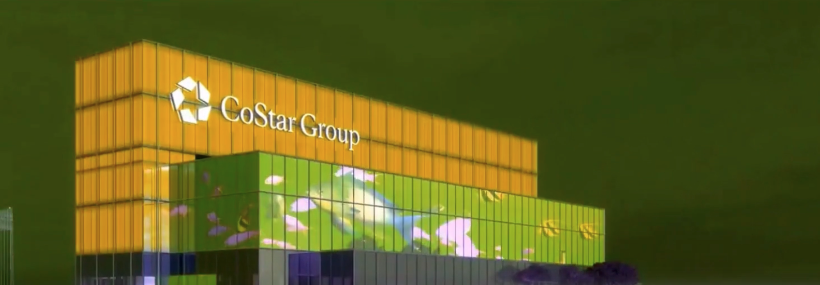
That phrase, “the city is your canvas”, could easily sound like marketing. In Soltech’s case, it lands differently because the technology does not ask the architect to choose between utility and expression. It offers both inside the same material logic.
This is where anticipation enters the story.
If Soltech is right, cities will not only consume energy in the future. They will produce it quietly, constantly and across surfaces we stopped noticing long ago. Façades, canopies, barriers, roofing, glass skins, infrastructure elements, maybe even streetscape objects. The built environment starts to behave less like static mass and more like a productive landscape.
There is something hopeful in that. Almost agricultural, in fact. Every exposed surface begins to look like a field.
Why Jeroen matters
This is where our own Jeroen comes into the story.
The easiest version of a patent attorney is a procedural expert: intelligent, careful, technically competent and largely invisible until a filing deadline appears. That version no longer fits companies like Soltech.
We have been making that case clearly ourselves. Jeroen Meesters writes that the modern patent attorney is no longer a distant specialist focused mainly on procedures, but an integrated strategic partner who helps shape ideas, guide investment and build lasting business value. His own profile at EP&C describes how patent law brings together creativity, technology, and language. Unravelling complex innovations and translating them into clear, legally strong protection brings Jeroen real energy that he can use in his work.
What excites me most is the privilege of supporting cutting-edge innovations and helping clients protect their visions. My work combines strategy, creativity, and technical expertise, ensuring clients can navigate IP challenges with confidence.
Inventors are building the future, Jeroen ensures their ideas are protected, so they can grow with confidence.
That is precisely the kind of role Soltech needs from Jeroen, and increasingly relies on.
Not someone who arrives at the end to document an invention, but someone who enters the conversation earlier and asks the awkward, useful questions. What part of this process is truly non-obvious? Where is the competitive hinge? What should stay broad, and what should stay narrow? Is this worth protecting in Scandinavia now, or only after commercial traction? Are we talking about a product patent, a process patent, a design right, a freedom-to-operate issue, or a trade secret? Are we protecting the visible surface, or the engine behind it?
Those questions change the quality of management decisions.
They also change speed. When a company is scaling, the real cost of weak IP advice is rarely the invoice. It is drift. Teams keep building, selling and entering markets before anyone has stopped to decide what the company most needs to own.
Jeroen helps prevent that drift.
The value is not dramatic in a cinematic sense. It is more useful than that. It is regularity, perspective and timing. It is knowing when to press, when to hold, when to broaden a claim, when to narrow a filing, when to look at a competitor’s portfolio, when to prepare for international expansion and when to use patents not only defensively but as part of the company’s commercial identity.
In a business like Soltech, that is not peripheral support. It is part of the operating system.
Why EP&C fits companies like Soltech
This is also what makes EP&C feel unusually relevant to start-ups and scale-ups.
Our own language is strikingly modern. At our Belgian office in Turnhout, we describe intellectual property as a strategic instrument for sustainable growth and presents our people not as distant consultants but as loyal partners who stand beside the client. More broadly, we believe IP protection should not start and stop with a patent, but should create lasting competitive advantage through collaboration and careful choice-making.
That tone matters because younger technology companies have very little patience for ceremonial advice. They want clarity, speed and commercial intelligence. They want someone who can explain complexity without draining momentum. They want budget realism. They want candour. They want a patent strategy that grows with the company, rather than a stack of filings that ages badly.
EP&C has built real fluency in that world. Our work with StartLife and StartHub shows a long-standing pattern of helping early-stage companies think about patent applications, freedom to operate and growth before it is too late. That habit of early involvement is exactly what ambitious technical businesses need, whether they are two years old or thirty.
Soltech may not look like a start-up in the conventional sense. It has heritage, industrial complexity and a long technical memory. But in strategic terms it behaves like one in the best possible way. It is still defining its category. It is still deciding what part of its future should be protected and monetised. It is still turning research capability into industrial repeatability. It still needs advisers who can think with entrepreneurial urgency.
That is why the EP&C relationship matters. Soltech is not buying a service. It is building a capability.
A company shaped by Limburg
It also helps that Soltech’s development is inseparable from the wider Limburg innovation story.
Thor Park has become a rare kind of place in Europe: a physical ecosystem where start-ups, scale-ups, research institutions, talent development and industrial activity reinforce each other in one location. The site gives companies access not only to buildings but to infrastructure, networks, testing space and adjacent expertise, from EnergyVille to IncubaThor to the Open Thor Living Lab.
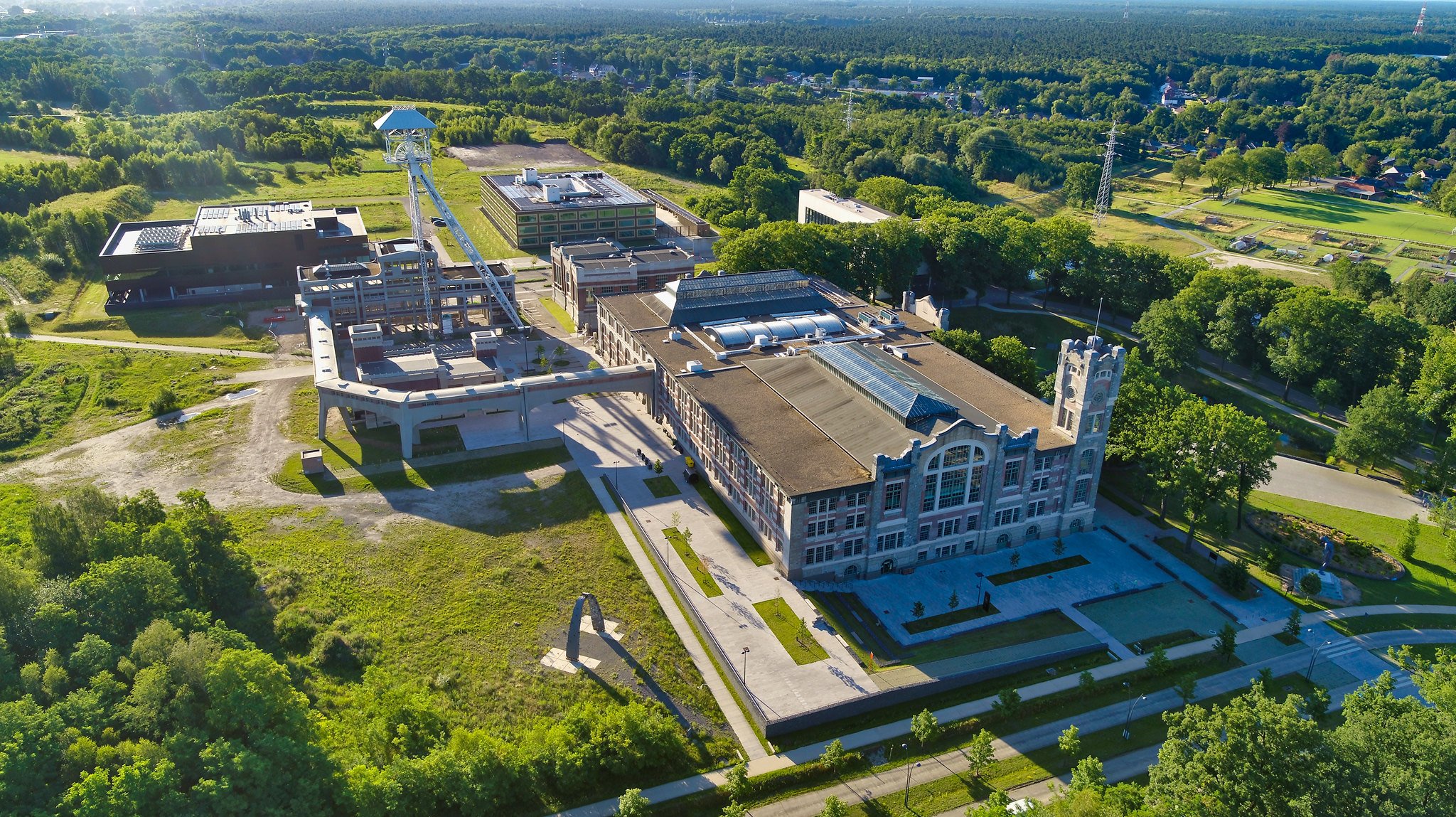
For Soltech, that proximity is not decorative. It shortens the gap between idea and industrialisation.
UHasselt, Imec and Soltech recently opened a 55-are test field at Thor Park for integrated solar technologies in structures such as canopies, vertical walls, noise barriers and agricultural applications. The purpose is not academic theatre. It is speed. New technologies can be tested, monitored and refined in a controlled environment without the normal drag of fragmented validation. In Van de Kreeke’s words elsewhere, the ecosystem gives Soltech the ability to test innovations emerging from the laboratory almost immediately against the reality of products built in the factory.
That is how regional ecosystems become business advantages. Not through slogans, but through shorter loops.
Soltech is a good example of what Limburg does well when it is working at its best: take deep technical knowledge, place it close to manufacturing, surround it with partners and then give it room to commercialise.
The skyline ahead
Van de Kreeke does not sound utopian when he talks about the future. That makes his optimism more convincing.
He sees building-integrated photovoltaics for offices, hotels and apartment buildings as close to inevitable. He is more selective about media façades, especially in Europe, where he expects them to remain more exclusive and iconic for now. Yet even that restraint carries anticipation. Because once a city has seen a building that generates power during the day and becomes a communicative layer at night, the mental model changes. The skyline no longer feels fixed.
Soltech’s own references already point in that direction, from integrated solar façades to glass systems that alter how a building presents itself without abandoning architectural coherence. The company’s OEM+ offer makes the same point in another way: its technology can move into other products, other materials and other categories, bringing energy generation into the core of an object rather than leaving it as an afterthought.
That is why the company’s transformation matters beyond its own balance sheet.
This is not only a story about solar glass. It is a story about the convergence of construction, data, aesthetics, manufacturing and IP. It is a story about what happens when a company stops asking how to sell more units and starts asking how to own a better system.
For Soltech, that system includes a flexible factory, a growing body of measurement data, deeper ties to the Limburg innovation ecosystem, and a stronger sense of where its defensible edge really sits. For Jeroen and EP&C, it means translating all of that into a patent strategy that serves growth rather than merely recording it.
The visible result will be the façade.
The deeper result will be harder to spot, but more important. A company that once risked being seen as a niche producer of advanced materials is becoming something else: a technology business with architecture as its medium.
And perhaps that is the most hopeful part of the story. In the next decade, cities may begin to look less like places that consume resources and more like places that quietly produce them. Walls will not stop being walls. They will simply do more. Roofs, screens, canopies and glass skins will not lose their beauty. They will gain a job.
Soltech is betting that this future is closer than most people think.
Through Jeroen and a more strategic approach to patents, we are helping make sure that when it arrives, Soltech owns more of it.